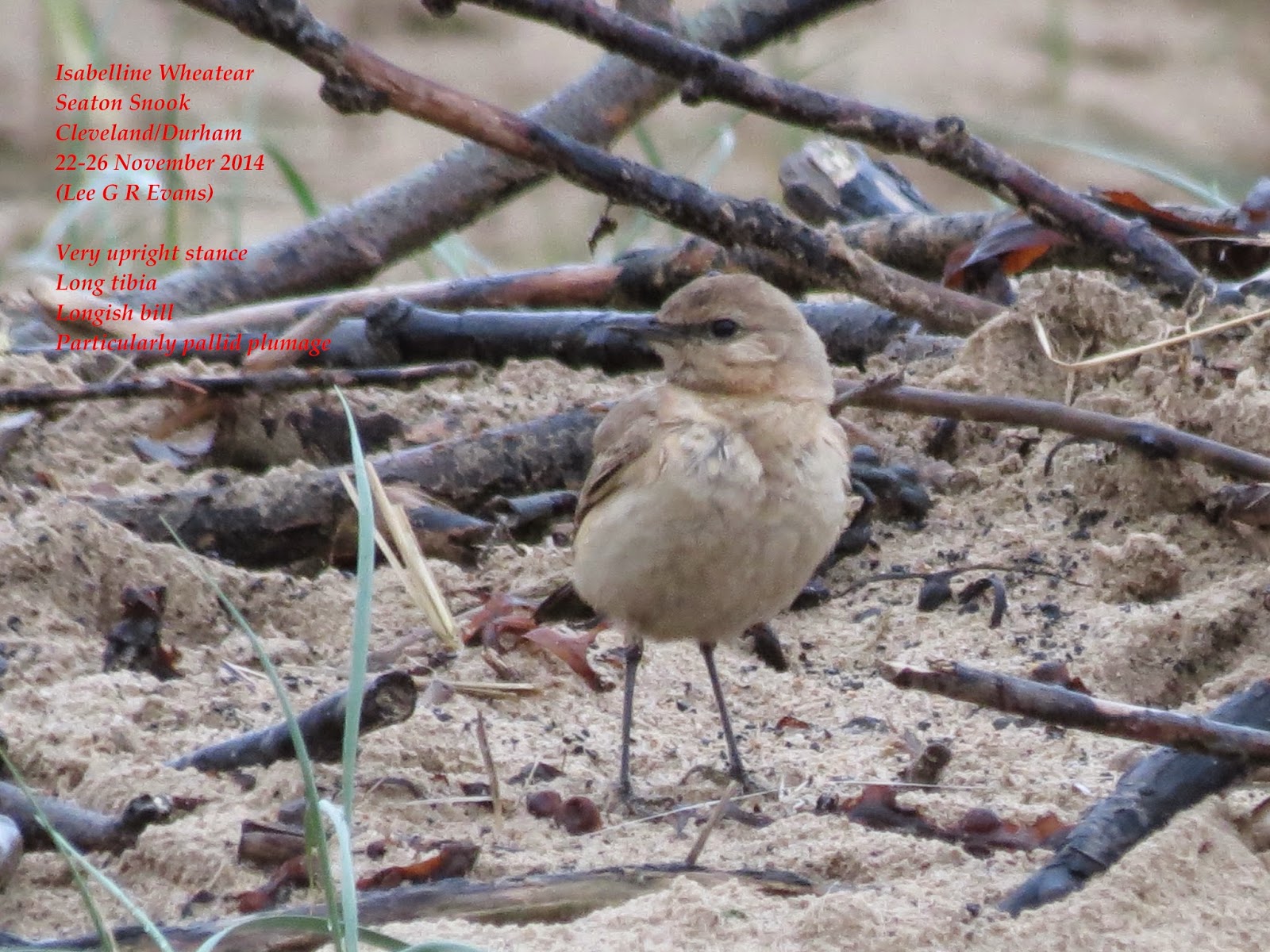
A 'wheatear' was first seen on the beach at Seaton Snook (County Durham/Cleveland) by a novice birdwatcher on Saturday 22 November 2014 but after it was subsequently seen next day by local guy Gary Flakes (who sensibly tweeted as such on his twitter feed), top county birders Chris Bell and Tom Francis visited the site expecting to find a Desert Wheatear. What they both didn't expect to find was they they were faced with a very pallid, long-legged, long-billed and staunchly upright individual - very quickly confirmed as County Durham's first-ever ISABELLINE WHEATEAR!!
The bird was showing exceptionally well on the sandy beach, either side of the end of Zinc Works Road in Seaton Carew, and remained on view until dusk on the Sunday allowing some 25 or so local birders to connect. Despite a clear and frosty night, it survived until next day and was still present on Wednesday 26th when I finally decided to make the pilgrimage.
Being a first-winter, the bird was surprisingly 'warm' for an Isabelline Wheatear, being tinged with warm buff in the flanks, and quite sullied on the underparts with some colour on the supercilium. Such individuals are quite tricky but this bird can be safely distinguished from Northern Wheatear on a number of characters, most noticeably the black alula feathers contrasting with the much paler upper wing coverts and rest of the wing, the broad black tail band, the long, pointed bill and in flight, the pale underwing. Supplementary characters include the thin supercilia extending behind the eye, the broad, dark, well-defined loral area, the pale ear-covert patch and the lankier appearance.
Additionally, often considered diagnostic (eg, by Lars Svensson & Keith Vinicombe) is the relative position of the primary tips - the wing tip of both species being formed by P3 and P4, which are similar in length. On the closed wing on Northern, the spaces between the primary tips at rest gradually become wider towards the wing-tip, with the space between P5 and P6 and P4 and P5 being similar in length (and quite long). On Isabelline, however, and illustrated in some of my images that follow, the space between P5 and P6 is distinctly LONGER than the space between P4 and P5.