See my latest blog post here - http://uk400clubrarebirdalert.blogspot.co.uk/2014/08/yet-another-blue-winged-teal-hybrid.html
Wednesday, 27 August 2014

Thursday, 6 February 2014
HORNED LARK complex now becomes six species
New science/studies have resulted in the highly expected splitting of Horned Lark Eremophila alpestris into no fewer than six
species by Drovetski et al. (2014).
Of
relevance in a Western Palearctic context are:
ELWES'S SHORE LARK: E.
elwesi of Tibet
etc. (to be renamed if the uninvestigated ssp longirostris proves to
belong to this clade).
CENTRAL ASIATIC SHORE LARK E.
penicillata
including ‘birds inhabiting alpine zone of Palearctic mountains from
southeastern Europe to Tian Shan’ (ssp albigula is found in Xinjiang,
China).
SHORE LARK E.
flava ‘breeding in
the tundra from Scandinavia to Amguema River in Chukotka’ (and occurring S in
winter at least to Beijing).
MONGOLIAN SHORE LARK E.
brandti ‘breeding in aridlands from the
northwestern border of Kazakhstan to northeastern Inner Mongolia in China’ (and
occurring S in winter at least to Beijing).
In addition
are ATLAS SHORE LARK E. atlas ‘inhabiting Atlas mountains of Morocco’ and NORTH AMERICAN HORNED LARK E.
alpestris of the New World.
Of relevance to the UK400 Club, this authority recognises the following British and Irish record -:
North American Horned Lark, St Agnes & Tresco, Scilly, 2nd-31st October 2001 (Birding World 15: 111-120)
Yet again
one has to look no further than http://www.netfugl.dk/ to find the right images, in
this case representatives of all six Horned Lark spp:
ELWES’S
HORNED LARK E.
elwesi of Tibet etc.
CENTRAL
ASIATIC HORNED LARK
E. penicillata including ‘birds inhabiting alpine zone of Palearctic
mountains from southeastern Europe to Tian Shan’ (ssp albigula is found
in Xinjiang, China).
SHORE LARK E.
flava ‘breeding in the tundra from Scandinavia to Amguema River in Chukotka’
(and occuring S in winter at least to Beijing).
MONGOLIAN SHORE LARK E.
brandti ‘breeding in aridlands from the northwestern border of
Kazakhstan to northeastern Inner Mongolia in China’ (and occuring S in winter at
least to Beijing).
ATLAS
HORNED LARK E.
atlas ‘inhabiting Atlas mountains of Morocco’ &
NORTH AMERICAN
HORNED LARK E.
alpestris of the New World.
Friday, 22 November 2013
CASPIAN STONECHAT on Scilly
A first-winter male CASPIAN STONECHAT has been present on St Agnes (Scilly) since Monday, showing well in St Warna's Cove. It represents only the 4th record for Britain and the first since the male at Virkie (Shetland) on 7th May 2006. The British Birding Association now recognises four species of stonechat on the British List - Caspian, Siberian, Stejneger's and Common.
Today, Chris Heard and I succeeded in our goal of seeing all four species of Stonechat in Britain, the bird affording fabulous views in the sunshine. I took well over 300 photographs of it, a small selection being reproduced here. It was not as well marked in the tail as we had expected, so was most likely a western individual, most likely from Turkey, Georgia or Armenia...
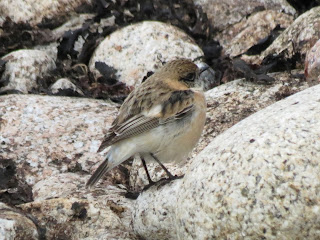


Today, Chris Heard and I succeeded in our goal of seeing all four species of Stonechat in Britain, the bird affording fabulous views in the sunshine. I took well over 300 photographs of it, a small selection being reproduced here. It was not as well marked in the tail as we had expected, so was most likely a western individual, most likely from Turkey, Georgia or Armenia...


Wednesday, 23 October 2013
Sunday, 22 September 2013
ITALIAN SPARROW now gone


The male ITALIAN SPARROW that had been present at Hungry Hill, Northrepps (Northeast Norfolk) from at least early July was last seen on 6 September. The bird's appearance totally matches that of Italian Sparrows at the northern limit of the species' range.
WILSON'S WARBLER in the Republic of Ireland
A male WILSON'S WARBLER spent four days residing on Dursey Island (County Cork) habitating a densely vegetated garden at the far west end of the island until Saturday 21 September. It represented the first record for Ireland and only the second for the Western Palearctic. Perhaps 65 UK twitchers connected including Richard Bonser, the highest-listing birder of the region. With little interest or appetite now from the majority of British birders in Irish rarities, it was surprising how many did actually make the effort - BUBO Listing, the site where many of these types log their sightings, treat Ireland as a separate entity and do not allow its UK listers to include Ireland (a separate country) within the totals. A nice bird though by the looks of it.
Friday, 20 September 2013
BROWN SHRIKE in Hampshire
Gone are the times when BROWN SHRIKE was a mega but this first for Hampshire was a nice surprise today.......Hampshire patcher Bob Marchant takes up the story.....


''Found the shrike at 09:55 this morning on brambles by the railings guarding
the Chilling
sub-station tunnel entrance (SU 500 042). Initially with a brief 2 minute
view in poor light
I considered it as a juvenile Red-backed Shrike. Not seen again for about 20 minutes
when it showed
in cover and further away by the Solent Way footpath , then flew over the
bramble patch
out of sight. I moved up to the footpath and refound the bird on the fenceline running NE
alongside
a large bramble patch. Although the bird was some distance away, some 80 –
100m,
the light was more favourable and it became apparent that the bird had more
of the
features of a 1w BROWN SHRIKE – chestnut head, brown upperparts not
noticeably
vermiculated, long brown tail with reddish rump/base of tail, short primary
projection
reaching only to end of reddish patch, buff underparts with noticeable
vermiculation
(when not in bright sunlight). The dark mask also continued to the front of
the eye
tapering down to the bill. Bare parts appeared grey, bill dark tipped. All of these salient features were confirmed with the gathering birders arriving on the
scene, although throughout the day the bird remained distant. It remained until dusk, by which time no less than 75 birders had connected''
I arrived on site at around 1600 hours and remained on site until 1830. Throughout this period, the bird was showing well but distantly along the fenceline, making frequent sorties to the ground for food. I took some 100 or so shots but all were just record - a selection of the best being published below -:


Subscribe to:
Posts (Atom)